Six bedrooms, up to 17 guests: how a big group actually fits at The Tamarack
By The Tamarack Team
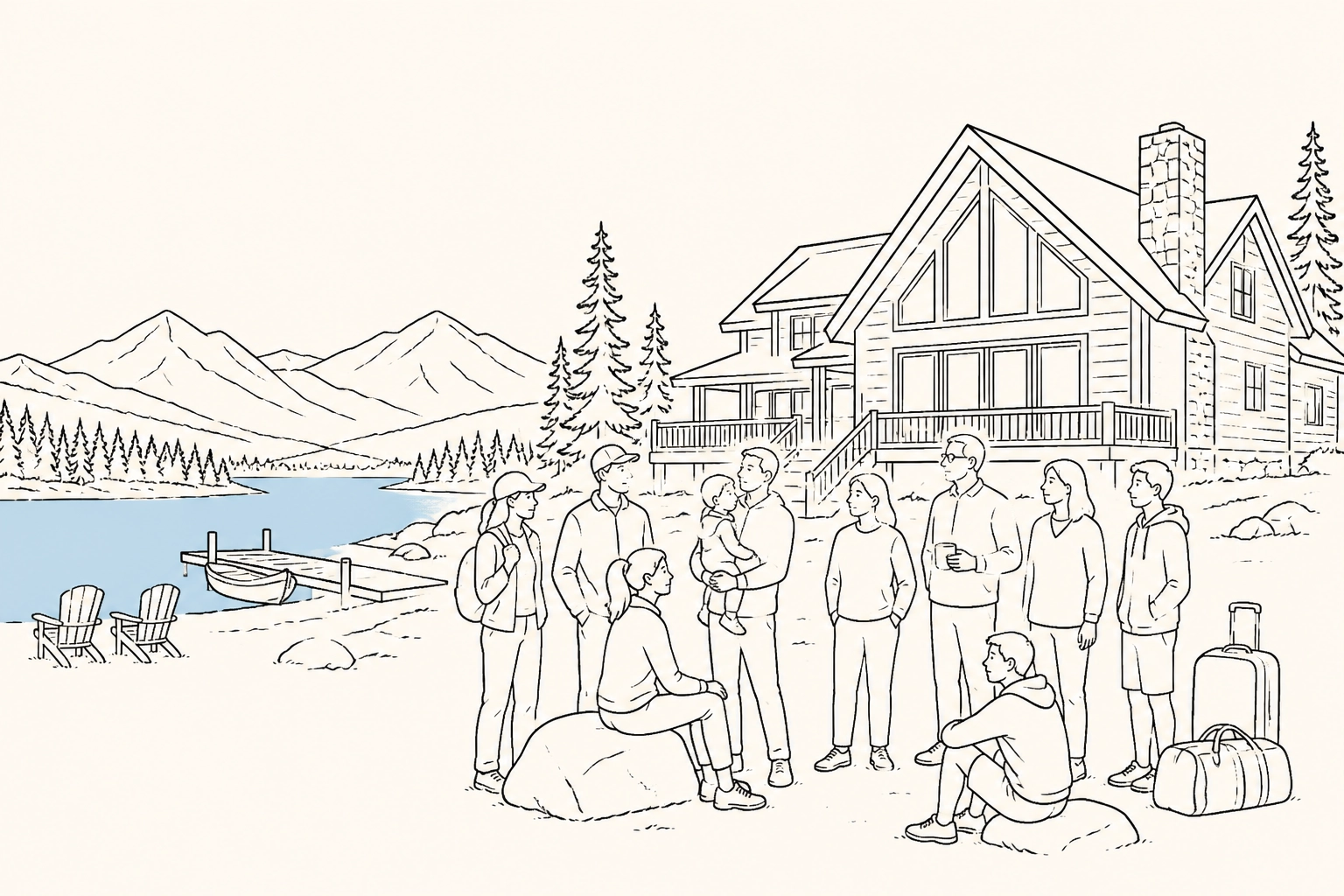
A group, a listing photo of the water: on paper, the search is solved. Then you start assigning rooms, counting parking spots, and asking what “lake access” actually gets you — and the details that decide the trip turn out to sit in the gaps between the headline numbers.
If you are comparing Lakeside Montana vacation rentals for a group, this post goes through The Tamarack in three places where listings stay vague: the bed plan versus the permitted guest limit, the specific kind of Flathead Lake access involved, and the county rules and total terms behind the stay. Get those answers first, then inquire with them in hand.
Two numbers, not one: bedrooms are a bed plan, not a guest limit
A bedroom count describes furniture. It is a bed plan: how many rooms hold beds, and roughly how many people those beds sleep. Permitted occupancy is a separate number — the maximum number of overnight guests the home may hold. For a group, the permitted number is the one that has to fit. The bedroom count only tells you how sleeping gets arranged once you know the group is allowed.
Where the permitted number comes from
In Flathead County, occupancy is not set by bedroom count. The commission first proposed two people per room, then changed the standard to whatever the sewage disposal capacity is. The limit follows the home's septic capacity rather than its furniture, which is why adding beds cannot move it. Check the current stay details for the permitted number instead of counting bedrooms and guessing.
The rule to keep in mind
Beds do not increase permitted occupancy. A sleeper sofa or an air mattress can rearrange who sleeps where. It cannot raise the number of overnight guests the home is permitted to hold — and that ceiling applies to the whole group, however creatively the sleeping is arranged.
The sentence to pass along
Give your people the permitted guest number, not the bedroom count. A bedroom count invites one more friend at the last minute. The permitted guest number settles the question before anyone books a flight.
Who actually sleeps where
The bedrooms are the bed plan. Whether that plan fits your group depends on who shares and who doesn't.
Map the people before the rooms
Write the group out before you look at beds:
The pairs who will share.
The singles who need their own room — or will double up.
The kids who can share with each other.
Anyone who needs privacy: a light sleeper, an early riser, a grandparent, a couple who wants a door that closes.
Then see how the bedrooms absorb that list. A group of couples uses the same house very differently from a mix of couples and singles. The pairs are usually the easy part; the singles are the squeeze. Reshuffle on paper before you book.
Treat the bathrooms as a schedule
Assign roughly one bathroom per household cluster for the morning window. Put the half bath to work at peak times — before breakfast, before a dinner out. Stagger wake-ups if everyone rises at once.
Arrival and departure for the group
The group brings its own load of luggage, coolers and boat gear. Decide where it stages — garage, mudroom, covered porch — and where wet towels, swimsuits and life jackets dry so they aren't draped over every railing.
For the home's own images and a conceptual view of the bedroom and bath arrangement, see the group layout notes. Any illustration is conceptual, not a measured floor plan or an actual photograph.
What "lake access" means on Flathead Lake — and what to verify before you rely on it
Listings blur three separate claims into one phrase. Lakefront means the property touches the shore. Lake view means you can see the water. Lake access means you can get to it — and it says nothing about how, or who owns the route. The Tamarack does not claim private lake access, and a view or a nearby shoreline should never be read as an upgrade to one.
Three kinds of public access, three sets of rules
Access around Flathead Lake can fall into one of these, and each carries its own season, fees and posted rules:
Public beaches — swimming and day use. Confirm season, parking and any fees.
Marinas — services and moorage. Confirm what is open to non-slipholders.
Boat launches — what boat owners need. Confirm ramp access, launch fees and hours.
Ask your group which it will use most: a launch if you are bringing a boat, a beach if swimmers set the agenda.
Verify the access point, not the listing
Beach hours, launch fees and posted rules change by season and by operator. Confirm the specific public access point your group plans to use, not the one in the last listing you read.
The water is cold, and it changes
Flathead Lake stays cold, and conditions shift month to month. Check Flathead Lake water temperature by month and local safety guidance before you plan swims. A vacation rental is never a supervised swim area: no lifeguard, no marked zone, no one watching but you.
The county rules behind the stay: permits, parking and the 24-hour contact
Flathead County adopted its short-term rental rules on August 7, 2017, by a 2–1 vote, and those rules shape how a permitted home may operate — what it may offer, how many cars may sit outside it, and who answers the phone when something goes wrong late at night.
The paperwork behind the listing
In zoned areas, a short-term rental needs an administrative conditional-use permit from Flathead County Planning and Zoning plus a state Public Accommodation License administered through the Flathead City-County Health Department. Whether the home is permitted is therefore a fair question with a real answer, not an awkward one.
Parking, then the rest
The county settled on “adequate parking” rather than a fixed number of spaces. That puts the math on the group: before everyone drives separately, confirm how many vehicles the property allows and where they go. Several cars arriving at once is a different stay than a single car.
A short list of county guidelines for permitted homes shapes arrival:
Homeowner-association and covenant compliance
No signage other than address numbers
A 24-hour contact for emergencies
That last item is why you get a phone number instead of a sign at the turn. Get permit status, the vehicle allowance and the contact in writing before you send the inquiry.
Choosing Lakeside instead of the next listing on the page
A search for Lakeside, Montana vacation rentals presents results the way the page does: one nightly price, one photo of the water, one scroll to the next listing. That is a ranking, not a fit. A couple of comparison axes do more useful work.
Season changes what the same house is for
A house that works as a swim-and-trail base in summer becomes a snow-and-quiet base in winter. Off-season dates also change what is open around you — lake businesses, launches and local event calendars included. Settle which season your group is actually traveling in before you compare properties.
Compare towns, not drive times
Bigfork, Polson and Kalispell each anchor a different kind of day. Instead of ranking houses by minutes from the water, ask which activity your group will repeat most — a town morning, a launch, a trailhead — and let that choose the town. Then confirm any distance or route detail against a current source, not a listing blurb.
For the context listings tend to leave out — where the public access points are, what each town is for, and how the season shifts the plan — start with the west-shore area guide.
Fit check: what to confirm before you send the inquiry
Write one list before you inquire. Four lines: the guest limit that currently applies, a bed-by-bed plan naming who sleeps where, the lake-access detail your group actually cares about, and any policy that affects your group. Then get each answer from the live channel listing for your dates — not from this post, and not from a search result that was cached earlier.
Price the stay as a total
A nightly rate hides the comparison. Add the rate for your exact dates, cleaning and other fees, taxes, and any minimum-stay requirement, then divide by heads. That per-person total is what makes two Lakeside options honestly comparable.
Read the terms before you pay
Cancellation window, payment schedule, and what changes if the head count moves by one. Ask that last question directly — it is cheaper to learn before the deposit than after.
If the head count is the wrong fit
If the head count turns out to be the wrong fit, ask whether pairing this home with a second solves it better than squeezing in.